Message from the Dean
The quiet, slower pace of summer has changed to the whirlwind energy of fall. Last week I enjoyed helping with Coug Move-In, attending Convocation, and reprising my favorite All-Campus Picnic assignment: Line 2 sign holder. That role gave me the opportunity to meet new colleagues and see lots of eager students.
While our library buildings on the Pullman campus are typically quieter during the summer months, our digital collections remain busy year-round. Ying Lee, our libraries data analyst, recently shared some impressive usage statistics that highlight the continued importance of our online resources. In July alone, researchers and students requested more than 40,000 e-books and downloaded over 140,000 journal articles.
Since the beginning of 2026, the WSU community has generated 455,338 e-book requests and more than 1.18 million article downloads. Our library-created databases featuring materials from Manuscripts, Archives, and Special Collections (MASC) received 660,204 page views. Open-access publishing agreements also continue to provide significant value. Through the Elsevier read-and-publish agreement, article processing charges (APCs) were waived for 95 articles, representing a savings of $362,210. The Wiley read-and-publish agreement waived APCs for 81 articles, saving WSU authors an additional $314,170.
I also wanted to share an update on Cougar Commons, our academic support center located in Terrell Library near the Ask Us! desk. Delivery of the new furniture has been delayed and is not expected until at least mid-September because of a delay in finalizing the purchase order.
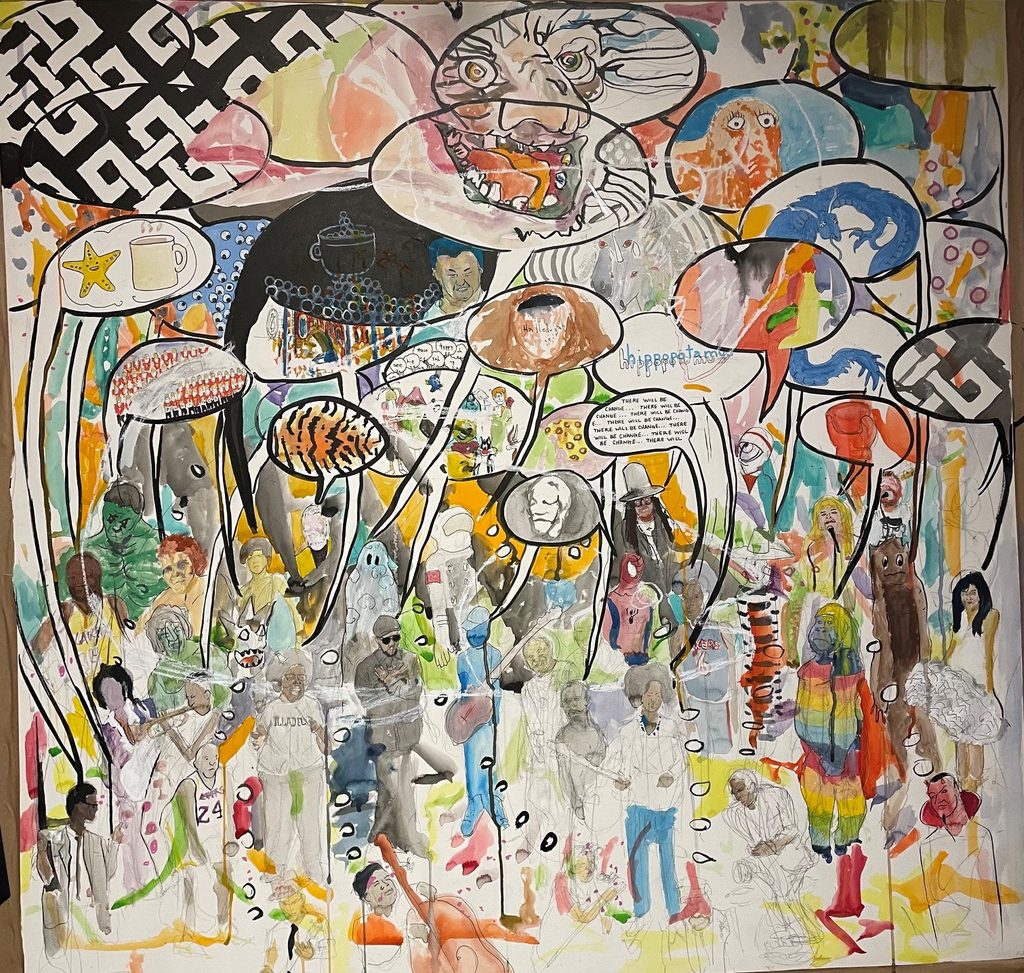
The delay does not diminish our excitement about the accompanying art installations that will help transform other Terrell Library spaces. Once the furniture arrives, we will celebrate the opening of three new works by faculty from WSU’s Department of Art. In the Quiet Study Lounge, Assistant Professor Jiemei Lin has created a stunning mural, Living Archive, inspired by the Gallup Collection of rare fishing books in MASC. We are planning an opening at 3 p.m. on Tuesday, September 29, in the Quiet Study Lounge. With support from the David G. Pollart Center for Arts and Humanities, Professor Kevin Haas installed An Incomplete Constellation, which brings together disparate fragments from the histories of science, technology, communication, and human invention, located on the ground floor near Current Journals; and Department of Art Chair Squeak Meisel added his custom-framed, mixed-media drawing Collectively Speaking of people, memories, cultural references, invented characters, and image fragments, located on the first floor near the north-facing windows. I am so excited about these spaces.
MASC will begin the fall semester with an exhibition highlighting one of its newest acquisitions: a rare mountaineering book collection donated in June 2025 by WSU alumni and renowned mountaineers John Roskelley and Chris Kopczynski. From 5–7 p.m. on Friday, September 25, Roskelley and Kopczynski will join us in the MASC lobby in the Terrell Library atrium for a reception and public conversation about the collection, mountaineering, their connection to WSU, and the role books have played in documenting climbing history. They will also sign copies of their publications.
Titled “Peak to Page: Exploring the World of Mountaineering through Rare Books,” the exhibition will feature selections from more than 350 important works on mountaineering published between 1892 and 2012. The collection was assembled by Roskelley, Kopczynski, and their mentor, the celebrated climber Joe Collins. MASC will also display newsletters from WSU’s Alpine Club, the student rock-climbing organization active during the 1970s.
This collection reflects the efforts of three lifelong climbers. Roskelley and Kopczynski, both members of WSU’s Class of 1971, began climbing as teenagers with the Spokane Mountaineers, where they met Collins. He led them on one of their earliest climbs, Mount Shuksan, and later watched them achieve international recognition in the mountaineering world. Beyond his accomplishments as a climber, Collins was an avid collector of mountaineering literature and signed editions. He encouraged Roskelley and Kopczynski to help expand the collection. The pair carried books from his library to climbing destinations around the world and returned them to Spokane signed by some of the most important figures in mountaineering history. For more details on the collection and the mountaineers, see the August 2025 story written by Will Gregg, MASC interim head; a more recent story by Adriana Janovich from Washington State Magazine, which is co-organizing the exhibit reception and program; and last month’s Browse article by Nella Letizia.

This issue of Browse also includes my essay about the WSU Libraries’ collection of rare John Senex maps. I welcome any opportunity to spend time with these remarkable 18th-century maps and enjoyed learning more about their provenance and their journey to WSU. Beyond their beauty and craftsmanship, the maps offer insights into how people understood the world more than three centuries ago. They are wonderful examples of the rare and distinctive collections that make the libraries a place of discovery, scholarship, and teaching.
Recently, I finished Emily Wilson’s translation of The Odyssey and enjoyed it so much that I am going to brush up on my long-forgotten ancient Greek. Before I turn to her translation of The Iliad, however, I plan to read the new WSU Press title by historian Todd Warger, The Mountain Runners: America’s First Adventure Race, 1911–1913, which tells the story of a now-banned race from Bellingham to the 10,781-foot summit of Mount Baker. The opening is so intense; imagine running in cotton clothes and tennis shoes up into a whiteout storm on top of the mountain with waist-deep snow and hidden crevasses. I am also looking forward to the upcoming sale of WSU Press books at the Terrell Library circulation desk, a great opportunity to discover some excellent reads while supporting the work of the press.
Trevor