History’s Ryan Booth Named 2026 Library Excellence Award Recipient
Ryan Booth calls it “the thrill of the hunt,” that moment when his WSU students visiting Terrell Library’s Manuscripts, Archives, and Special Collections for research find an article or some archival manuscript that really helps with their topic. He knows exactly what the students are feeling, having hunted the yet-hidden key in the MASC collections to unlock his own research questions.
“When you find one, then you want to find more, and it just cascades into a wonderful project for all involved,” he said. “It’s infectious.”
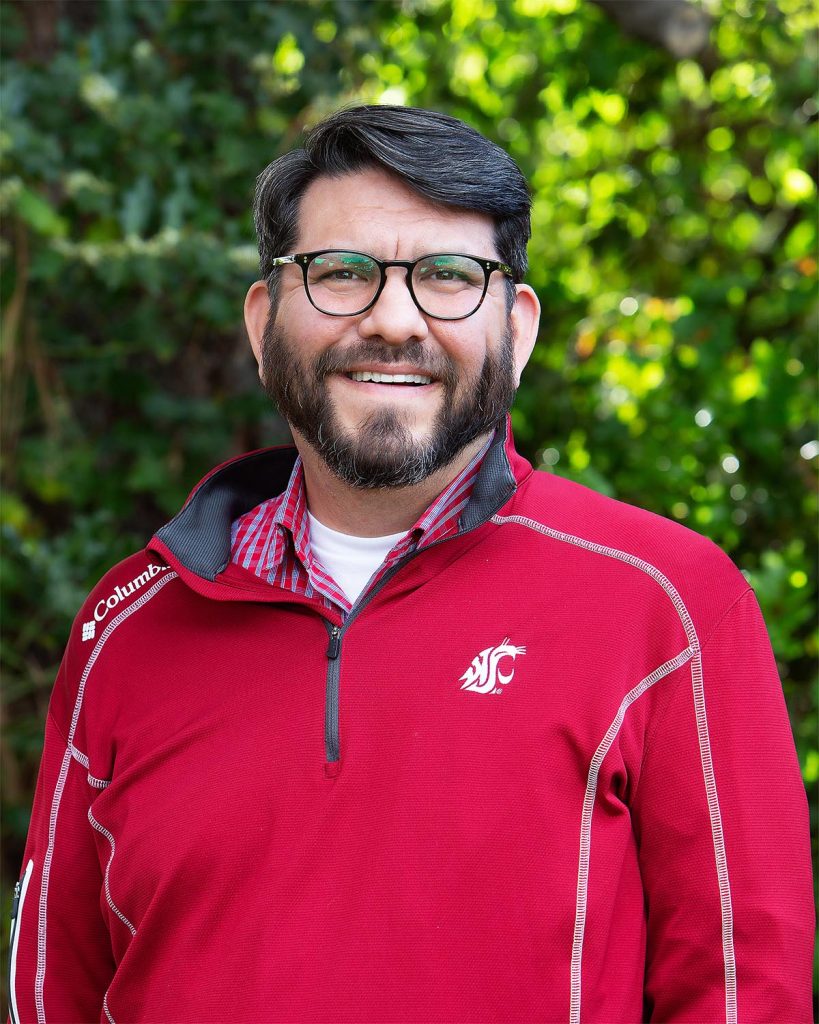
For introducing the allure of WSU Libraries’ archives and other library spaces to undergraduates—and igniting the careers of many future history researchers and scholars—Booth, an assistant professor in WSU’s Department of History, has been named the 2026 Library Excellence Award recipient.
Booth will be presented with the award during an in-person event at 2 p.m. Wednesday, May 6, in the Terrell Library atrium. The presentation is free and open to the public, and refreshments will be served.
The award recognizes a non-library WSU faculty or staff member who has shown consistent support for the WSU Libraries. Recipients are chosen based on encouraging students to use the libraries; personal use of the libraries; personal support of or contributions to the libraries’ collections or services; interaction and cooperation with library faculty; and service on library-related committees.
“I do not say this lightly, but I say it often that WSU Libraries are the heart of our university,” Booth said. “You pump the lifeblood of knowledge into our students, our research, and our community. It also helps that you are all some of the coolest, kindest, and most talented group of colleagues at this institution.”
‘Co-teaching experiences’
WSU librarians and award nominators Erin Hvizdak, Will Gregg, and Corey Johnson said in working with Booth over three years, he has made a significant mark on student success through his integration of WSU Libraries and MASC into his HIST 469 and HIST 300 classes, bringing in students multiple times per semester to ensure that they feel comfortable not only using the resources, but also navigating roadblocks and seeking help from library faculty and staff.
“He truly advocates for the importance of libraries throughout the college experience, not just in history classes,” the librarians said in their nomination. “We feel that sessions with Dr. Booth’s classes are less like lectures and more like co-teaching experiences, demonstrating his engagement.”
Librarians and staff are indeed co-teachers in Booth’s courses. For the last two years, he worked with Hvizdak and Gregg to design and carry out an assignment about tribal fishing rights in which students choose a Pacific Northwest tribe to do historical research on and create posters for the Terrell atrium, making their work visual and relevant.
“This was a fun project to plan with Erin and Will,” Booth said. “We had never done an academic poster project before at this scale—a whole class producing posters for display at the library.”
Fisheries is a natural topic for every Pacific Northwest tribe, and fishing their lifeblood, he said. Also central to every regional tribe are the 1855 Stevens Treaties, negotiated by Washington Territory Governor Isaac Stevens to take more than 100,000 square miles of land from eight Pacific Northwest tribes for non-Native settlement.
The treaties displaced the tribes and moved them onto reservations, but preserved their rights to hunt and fish on their ancestral grounds. That provision set up future clashes over 100 years between the Pacific Northwest Indigenous peoples fishing off-reservation in their traditional places and a government that didn’t honor the treaties and arrested Natives for violating state law that favored commercial fishing.
The Fish Wars of the 1960s and 1970s by Puget Sound tribes culminated in the 1974 Boldt Decision, allowing Washington treaty tribes to take up to half of the harvestable salmon in western Washington, reaffirming tribal treaty-reserved rights, and establishing the tribes as co-managers of Washington’s fisheries.
Indigenous fishing rights encompass more than access to salmon and other fish species, Booth said; they also speak to culture, water, dams, pollution, and more. The majority of his students starting out on the poster project think it will be boring to study salmon, but by the end, they often understand the importance of the Stevens Treaties and that “salmon are key to our way of life.”
“It isn’t about us versus them. It becomes just us,” he said. “We all share in this place we call home.”
Two crossed arrows
A year ago, Booth combined his love for the WSU Libraries with his own Native lineage and connection to the Stevens Treaties when he drove to Olympia personally to pick up a maquette of Nisqually activist Billy Frank Jr. and bring it back to display in Terrell Library for several weeks.
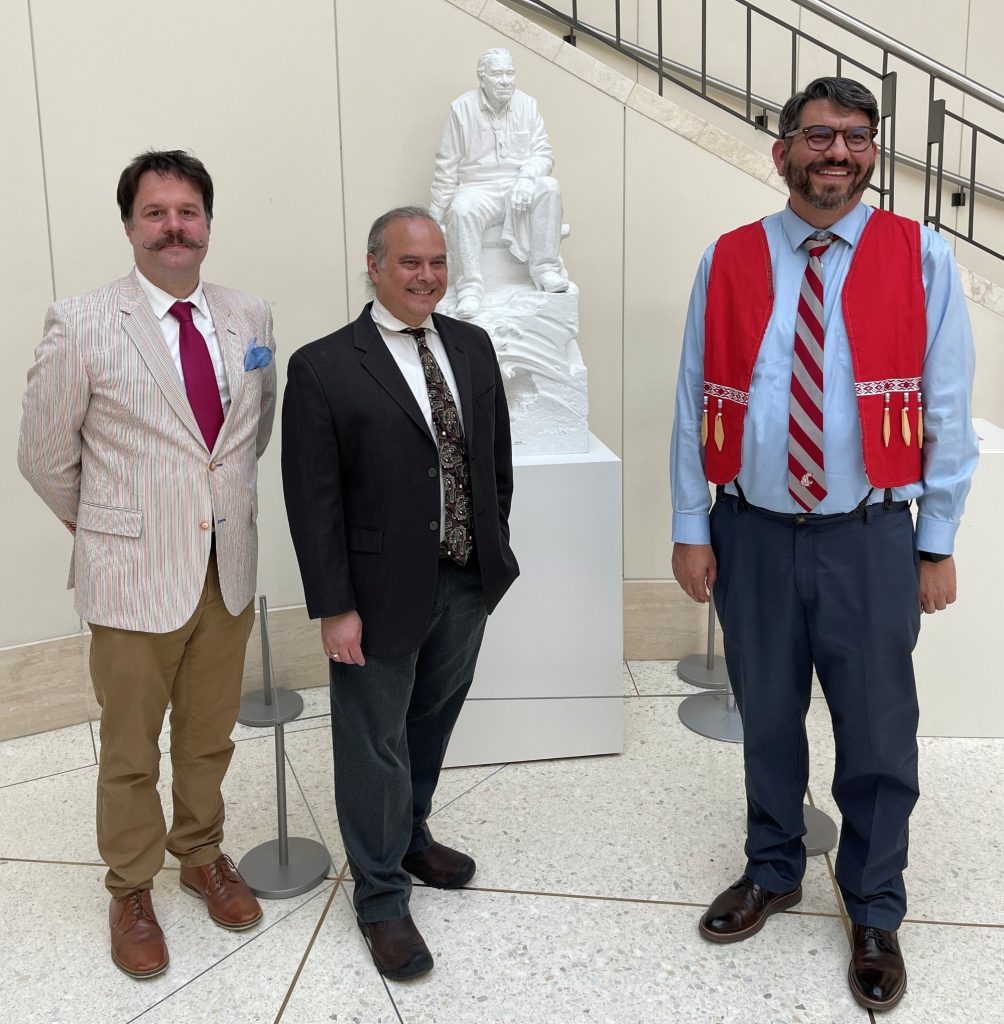
Pullman was one city the half-scale model visited on a statewide tour sponsored by ArtsWA and the Nisqually Indian Tribe. Frank’s final bronze statue will be part of the National Statuary Hall Collection in the U.S. Capitol in Washington, D.C., and at the Washington State Capitol in Olympia. (This article tells more about the maquette and Frank.)
Booth is an Upper Skagit Tribe member whose tribal name is “keaho,” derived from the traditional Hawaiian word for “altar,” a fitting choice since he was a Jesuit seminarian before his arrival at WSU as a doctoral student in 2019. His community, like the Nisqually, were among the original tribes bound by the Stevens Treaties, and both Indigenous peoples fought for treaty rights. Booth also had the honor of meeting Frank 20 years ago, what he called an unforgettable experience.
“When the statue made it into the van that day, it felt almost like carrying an honored loved one,” he said in April 2025. “It wasn’t the feeling of a funeral. It was more like an honoring or celebration.”
Booth specializes in the history of the United States in the 19th and early 20th centuries up to World War I, particularly Indigenous and military history. The blend of both histories started with his 2021 dissertation, Crossed Arrows: The U.S. Indian Scouts, 1866-1947, which he’s revising into a monograph due out in 2027 or 2028.
In the dissertation, Booth argues that U.S. Indian Scouts were central architects of American expansion in the West, whose strategic service to the U.S. Army both enabled federal conquest and reflected deliberate, constrained Indigenous choices that reshaped their communities and the trajectory of the U.S.-Indian Wars.
The premise turns traditional discourse on its ear by challenging a limited history of Native scouts as powerless, nameless pawns of a mighty American colonial military force. But Booth’s research shows that their choices to serve in the Army show their agency—and a reciprocal relationship that has implications for today’s Native versus non-Native narrative. The insignia for the Indian Scouts featured two crossed arrows. In 2012, the U.S. Special Forces changed their insignia to adopt the same crossed arrows.
“The crossed arrows reflect cross-purposes—civilization by savage means,” Booth noted in his dissertation. “Tribal communities across the nation still feel the effects of the U.S.-Indian Wars. Part of the reason for this is the silence over the brutal massacres of Native people on the wrong side of the U.S. government. Part of the reason for the silence might be the involvement of U.S. Indian Scouts in these bloody engagements. This is the true legacy of conquest.”