Seeing Through Paper: Light Sheet Reveals Printing in MASC’s Early Printed Books
By Trevor James Bond
If you’ve ever wondered how old a book really is—or where its paper was made—the answer may be hiding in plain sight. In Manuscripts, Archives, and Special Collections (MASC), a newly purchased light sheet (or flexible light panel) now helps researchers see through the page to the structures and watermarks embedded in early paper.
With more than 5,000 books printed before 1800 in MASC, this tool is opening new possibilities for the study of early printed books. We acquired the light sheet with funds generously donated by supporters to MASC development.
What does a light sheet do? Unlike reflective lighting that shows surface features, transmitted light shines up through the page, revealing the paper’s internal architecture: watermarks and countermarks, chain and laid lines, fiber distribution, and even faint or erased annotations. For scholars, those details can corroborate dates, identify where the paper was made, and trace a book’s path through time.
“The light sheet is an essential aid for research in literary history,” said Will Hamlin, WSU English professor. “It aids the study of provenance, it helps with deciphering handwritten annotations in old books, and it enables more accurate dating.”
“Many books and manuscripts from the European Renaissance are either undated or bear a false imprint to make them seem older—or newer—than they are,” Hamlin said. “But watermarks in the paper, which become highly visible using a light sheet, allow us to date these books and manuscripts accurately, since book-history experts have determined which marks were used by which papermakers at which times and places.”
This is all possible because of how early European paper was made. By the mid-13th century, Fabriano, Italy, was a renowned papermaking center. European mills used cotton and linen rags—collected from worn clothing—sorted them by color and quality, washed and cut them, and prepared fibers through fermentation before beating them to pulp.
Fabriano papermakers perfected the two-part mold (with a deckle frame), which shaped the sheet as it was lifted from a vat of roughly 10% pulp and 90% water. The wet sheet was then layered onto felt, pressed, dried in a loft, sized with gelatin (made from boiled pieces of animal hide, ears, feet, tripes, and other bits) for better writing and printing, and made smooth.
They also introduced wire-formed watermarks sewn onto the mold’s screen—marks that, centuries later, become strikingly visible with the light sheet and serve as fingerprints for dating and locating paper. These techniques spread throughout Europe and America.
In Hamlin’s own work on the first English translation of Montaigne’s Essays, the light sheet has enabled him to determine that the paper used by the London printers was imported from northern France. This is because French paper was far superior to English paper in the early 17th century.
“The London printers must have believed that the Montaigne translation deserved high-quality paper so that it would be attractive and durable, and this in turn meant that the book would be more expensive,” he said. “But the translation sold well and a great many copies have survived, so the publishers’ gambit was successful,” he added.
MASC’s collections offer rich opportunities for this kind of analysis, including three 17th-century English translations of Montaigne (1603, 1613, and 1632). The oldest printed book in MASC is De Sollicitudine Ecclesiasticorum by Jean Gerson, published in 1470. While not remarkable for its text, it is rubricated—showcasing hand-applied color over printed type, a perfect pairing with light-sheet study of paper and production.
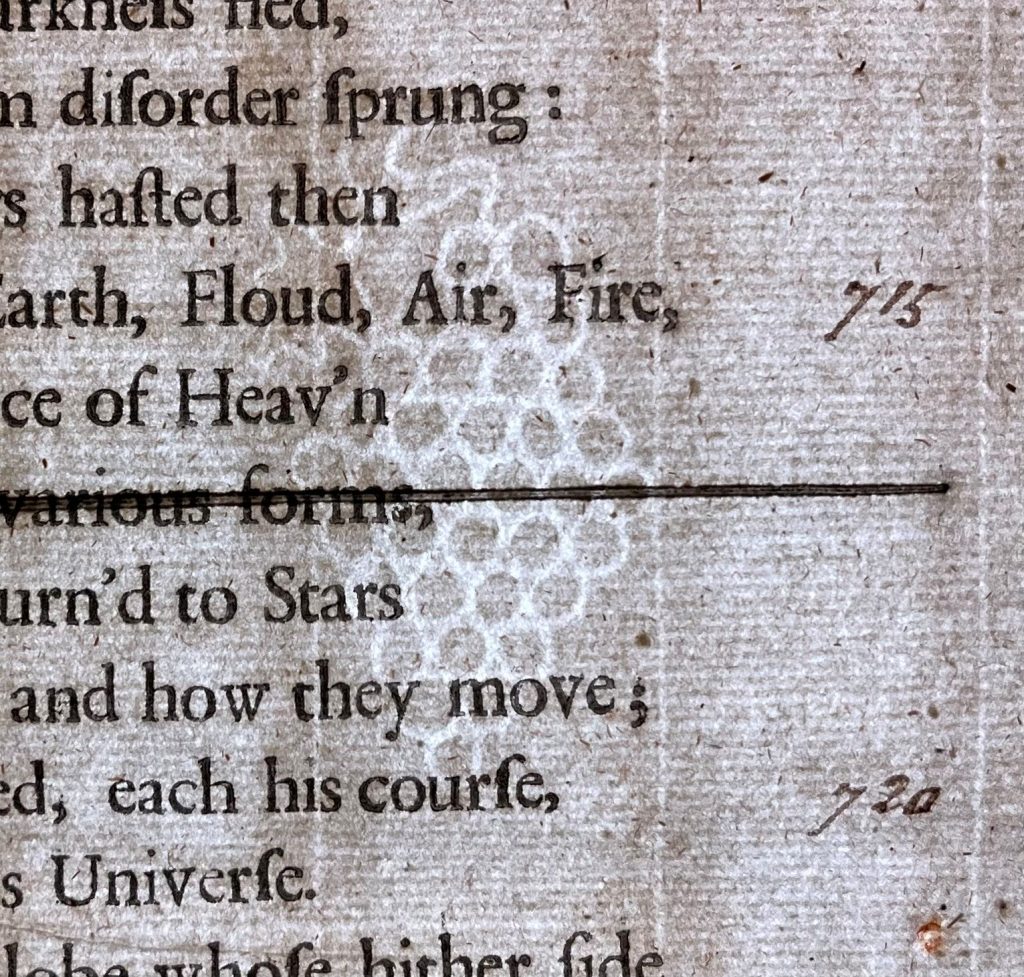
One of my favorite books in MASC is the 1688 edition of Milton’s Paradise Lost, which includes 12 stunning full-page engravings and the bold signature of book owner “Michael Dunn, his Book, 1799.” The paper’s watermarks vary between the makers’ logo and a bunch of grapes.
In the reading room, MASC staff collaborate with faculty, students, and visiting researchers to document material evidence that can be folded into catalog records, digital projects, and teaching. The light sheet is already helping us see the past more clearly. Thanks to donor generosity, its glow now illuminates centuries of craft, publishing, and readership—one page at a time.
Interested in working with the light sheet or bringing a class to see it? Contact MASC to schedule a session or discuss a project.